
NEW HAVEN, Conn. (WTNH) — New polling conducted on behalf of the gubernatorial campaign of Erin Stewart, the former mayor of New Britain, shows the 38-year-old Republican with a commanding lead in the race to win her party’s nomination.
The poll results were compiled in a campaign memo obtained by News 8 on Thursday.
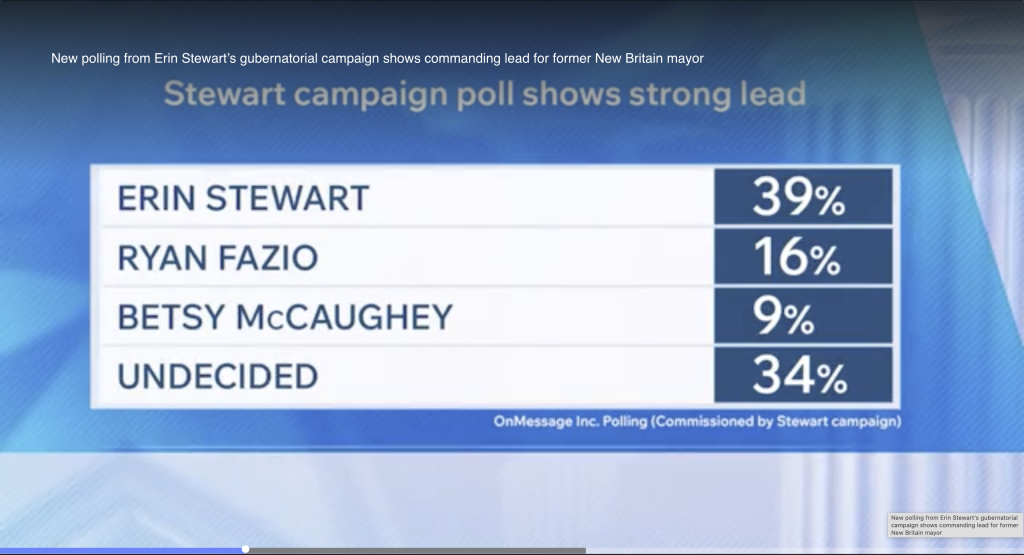
A question testing a hypothetical three-way primary between Stewart, State Sen. Ryan Fazio and Betsy McCaughey showed Stewart capturing 39% of support. Fazio garnered 16% support and McCaughey came in third with 9%. Thirty-four percent of respondents were undecided.
“Erin Stewart has a clear competitive advantage,” Morgan Wilson, a senior advisor to the Stewart campaign and vice president at the firm that conducted the polling, said. “Republican candidates would be better served by recognizing what the voters clearly do and uniting around Erin Stewart, the clear frontrunner who is best positioned to win and fix Connecticut.”
Fazio campaign calls Stewart’s poll “fake”
Any time a campaign discloses the results of its own internal polling, accusations of biased methodology and tainted results inevitably follow. The latest Stewart poll is no exception.
“Instead of ‘something different,’ Stewart is simply offering politics as usual: another fake ‘push’ poll meant to deceive Republican voters,” Jim Conroy, the chief strategist for Fazio’s campaign, said.
John Healey, a senior advisor to Stewart’s campaign, challenged the Fazio campaign to release polling data of their own.
“If his campaign thinks our numbers are wrong, they have to come forward with polling that proves it,” Healey said.
Asked if they had any polling numbers to share with News 8, the Fazio campaign declined.
The accusation that Stewart is conducting a so-called “push polling” is not a new charge from the Fazio camp and other Republicans who are skeptical of Stewart’s projections of strength. That term generally refers to polls with questions intended to sway respondents toward a particular viewpoint.
What’s in a poll?
The Stewart poll was conducted by a Republican consulting firm, OnMessage Inc., working on behalf of the former mayor’s campaign. The memo said the survey queried 300 likely Republican primary voters through live phone interviews and was conducted in the first week of February.
The firm’s polling operation has an ‘A’ rating from respected statistician and political scientist Nate Silver, the same mark as independent pollsters such as The New York Times/CBS News, Emerson College, and Monmouth University. OnMessage’s top pollster, Wes Anderson, was once named “pollster of the year” by a nonpartisan professional association of political consultants.
Reputation aside, the Stewart campaign memo outlining the results did not include so-called “cross-tabs” which display detailed data on poll responses, nor did it list each question in the survey and the order those questions were asked. Such information is typically released by academic institutions that conduct independent polling. In the absence of those details, it is difficult to independently assess the design of the poll. The Stewart campaign said that the hypothetical primary question was asked up front — a method campaign operatives refer to as an “uninformed ballot question.”
Conroy criticized the Stewart campaign for not disclosing a more detailed accounting of the poll’s methodology.
“This ‘push’ poll’s poorly veiled intent is only to disseminate dishonest attacks on [Stewart’s] leading Republican competitor,” Conroy said. “Stewart is clearly concerned by the momentum behind Ryan Fazio’s campaign.”
Typically, campaign polling begins by testing the uniformed ballot question to get a baseline on candidate support and name recognition. Then, respondents are presented with a battery of prompted questions. The questions usually test the effectiveness of lines of attack on each candidate, including the candidate who commissioned the polling, in a process called “message testing.” After the message testing is complete, candidate preference questions are asked again in an “informed ballot” question.
The Stewart campaign memo said the informed ballot yielded a substantial increase for the former mayor but did not provide details on how large that increase was or the messages the poll tested.
McCaughey projects strength
Reached by phone on Thursday afternoon, Betsy McCaughey offered a brief response to the poll results before ending the interview.
“I can assure you that the support in Connecticut among stalwart Republicans for me is enormous,” she said.
McCaughey, a former lieutenant governor of New York and conservative cable television presenter, has injected new energy into the race, which was for many months viewed as a two-way race between Stewart and Fazio. Her late entrance, however, puts her at a structural disadvantage. Both Fazio and Stewart have raised the required amount of small-dollar donations to qualify for the state’s system of government-funded campaign grants. Those grants will provide the two qualifying candidates with more than $3 million to wage a primary campaign — funds that are used for paid advertising, staffing and polling.
McCaughey is still actively fundraising to qualify for the grant.
A popular incumbent governor looms over GOP contest
Given that the Stewart campaign poll surveyed likely Republican primary voters, no data was collected on a hypothetical head-to-head matchup for the general election.
Gov. Ned Lamont, the Democratic incumbent, has enjoyed consistently high approval ratings in recent years. The latest nationwide survey from Morning Consult showed the governor with a 63% approval rating, making him the fourth most popular governor in the country. A November poll from the University of New Hampshire found Lamont had a 55% approval rating.
Republican Party delegates will convene in May for their state convention. Those delegates will formally endorse a Republican candidate. The endorsed Republican will appear on the party line in the August primary, when GOP voters will have the final word on who appears opposite the Democratic candidate in November.